Puttalyze
How to use the app
This section contains explanations of the used terms and notations as well as links to further material.
Step by step
How to Use the Puttalyze App
On the Putting Green
- Measure the green with a stimp meter.
- Adjust the speed at the hole.
While Practicing on the Green
- Find a reference point (e.g., a tree) to align your device.
- Place your device on the hole, tap on Measuring Mode, and then on Start. Wait for 5 seconds.
- Tap on Next, and then Next again. While the app counts down to 0, turn your device towards the ball.
On the Course
- Align your device towards the middle of the fairway (known as the Playing Line).
- Place your device on the hole, tap on Measuring Mode, and then on Start. Wait for 5 seconds.
- Tap on Next and then Next again. While the app counts down to 0, turn your device towards the ball.
Measurement Completed
- The following information will be displayed: Slope Percentage, Fall Line Angle, Difference from Fall Line.
To Conclude
- Tap on Done.
- Then enter the distance between the hole and the ball.
- Finally, tap on Compute.
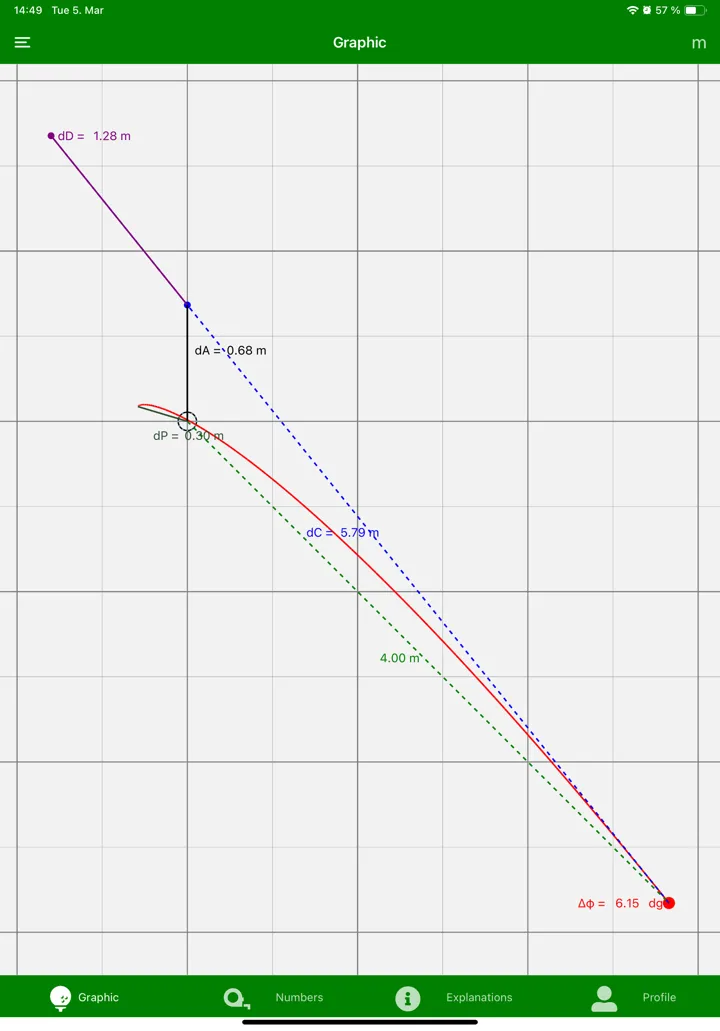
- The graphic displays the putt: length to the hole, total length of the putt, length between the target point and length point, putt's curve, length between the hole and endpoint.
Explanation of used terms and notations
Points, distances and lines according to the PUTTALYZE concept
- AIM POINT (PA)
- The point on the fall line that indicates the initial direction of the putt.
- Distance point (PD)
- The point on the line of the initial put direction that indicates the effective length of the put, i.e. the distance corresponding to a put on a flat surface (with the same green speed and velocity at the target).
- dA
- Distance between the hole and the aim point PA. (dA) Stands for the distance between the hole and the aim point PA on the fall line of the green. The fall line is the steepest and most direct slope or direction of the green from the highest to the lowest point. It represents the path a ball would take if it were not affected by breaks or undulations on the green. Understanding the fall line is crucial for golfers to predict the trajectory of a putt based on the green's slope.
- dD
- Distance between the aim point PA and the distance point PD. The importance of the distance between the aim point (PA) and the distance point (PD) cannot be emphasized enough in putting success. The distance between these two points varies based on the type of putt direction to the fall line and green conditions, and golfers must consider green speed to calculate it. The aim point (PA) is the target where the putter should aim, while the distance point (PD) is the spot where the ball would come to rest if the surface were flat. Green speed and ball position relative to the fall line affect the force required to get the ball from aim point (PA) to distance point (PD). Understanding the difference between aim point (PA) and distance point (PD) is crucial for making accurate putts.
- dP
- Distance past the hole; the distance from the hole to the point where the ball would stop, if it did not fall into the hole. An optimal speed of 1 mph (ca. 3 rps) at the hole is ideal for putting, as it improves the chances of success by optimizing hole size and ball roll consistency. A slower speed would make the ball to be self-controlled, while a putt with too much speed can result in a longer return putt and a smaller effective hole size. Golfers must consider green speed and slope, as well as the distance to the hole, to determine the best aim point and minimize the distance past the hole (dP). By paying attention to distance past the hole, golfers can improve their chances of making a successful putt.
- dC
- Distance corresponding to a putt on a plane surface. The distance for a putt on a flat surface refers to the length the ball rolls before it comes to rest. In golf, this distance is an important factor for golfers to consider when making a putt. The speed, aim and trajectory of the putt all contribute to the final distance of the ball on the plane surface. By mastering these elements, golfers can improve their chances of making a successful putt and lower their scores on the course.
- Error in putt direction
- Deviation (in degrees) of the putter from the calculated initial direction; helps to visualize the error margins. A small deviation can indicate a consistent and accurate putting stroke, while a larger deviation can indicate that the putter is not being aimed correctly or that the stroke is not consistent. By identifying the deviation, golfers can make adjustments to their technique or equipment to improve the accuracy of their putts.
- ∆φ ("Delta-phee")
- Angle between the initial putt direction and the straight line from the ball to the hole.
- Stimp-meter distance (Ds)
- The distance in feet that a golf ball rolls when launched from a Stimp-meter on a flat surface. It is an indicator of the speed of the green and can be used to compare the speed of greens between different golf courses or between different greens on the same course. The further the ball rolls, the faster the green. The Stimp-meter distance can vary depending on the type of grass and the weather conditions, so it is not a definitive measure of green speed; it can also be affected by the maintenance of the green and how it has been mowed, rolled and brushed.
- Fall line
- The fall line is the direction of maximum slope (SLmax): the direction that a golf ball would roll on a putting green if it were only affected by gravity. It is the line that is most directly downhill and perpendicular to the contour lines of the green, which connect points of equal elevation. While the fall line is a helpful reference, it is not the only factor to consider when putting, as other factors such as wind and ball speed will also affect the putt.
If you want to receive information about updates, podcasts and other new features: Contact us